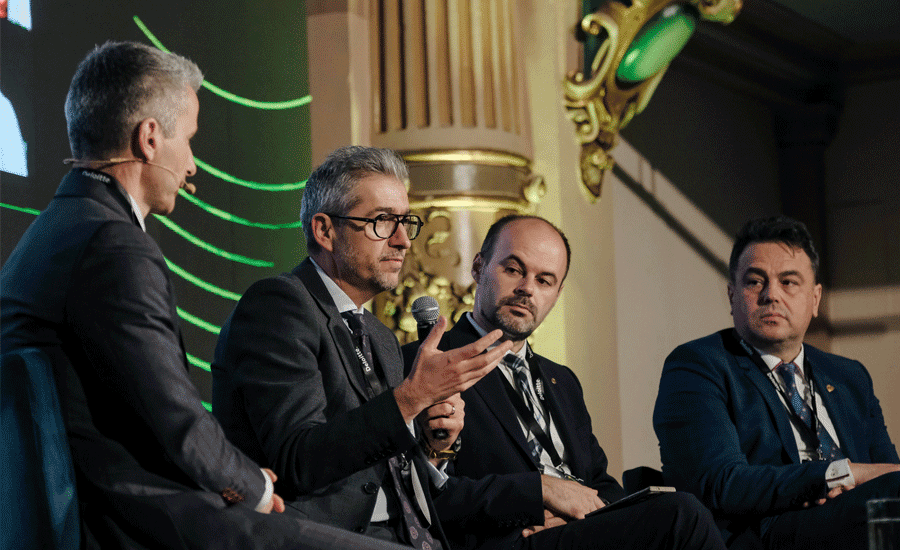
Tiberiu Moisă, BT: As companies grow, capitalization matters, but not for very small businesses

Tiberiu Moisă, Deputy CEO for MidCorporate & SME, BT, messages for entrepreneurs:
What would the requirement to have a bank account change for entrepreneurs
- You can get by without a bank account — at first glance, it looks like the option with fewer complications. Maybe today you operate on cash only, but over time your customers will want more.
- Even with an account, a good share of your business can still be conducted in cash.
- An account gives you access to a world with options worth exploring — from tailored financing solutions to financial education.
- Many of the things that move us forward first appear as obligations we think we could do without.
If you run a very small business, you may be able to get by without a bank account — and indeed many entrepreneurs choose that path. At first glance, it seems less complicated, with simpler bookkeeping — a choice most likely made by small family subsistence businesses. But is it really better? What would a requirement to have a bank account change?
Even with a bank account, a large share of your activity can still be cash-based, just as before. Having an account doesn’t limit your flexibility; it gives you access to a world with options worth exploring. Maybe today you manage on cash only, but in time your customers will want other ways to pay. Having those options at hand, being familiar with them, and using what fits your business — all of this can make the difference. In recent years, banks have become increasingly attentive to the needs of small businesses. There are financial education programs and financing solutions tailored to businesses of any size. Why not keep up with all of that?
Many things that move us forward first show up as obligations we think we could do without. In this case, though, you can keep the flexibility of a small business — work the way that suits you — and still have a bank account at hand.
Raising the minimum share capital for SRLs to 8,000 lei
- For very small firms, we support removing barriers to entering business, promoting financial and digital inclusion, financial education, and an environment that makes it easier to start a company.
- Capital formation can also be encouraged through other means.
As for the minimum share capital, at 8,000 lei we cannot really speak about capitalizing a business, and there are other ways to encourage capital formation. For very small firms, we support removing barriers to entering business, promoting financial and digital inclusion, financial education, and an environment that makes it easier to start a company. As firms grow, capitalization becomes relevant and is, without doubt, an important discussion for Romania. But not for very small businesses.
How much can financial inclusion increase? And banking penetration? It depends on what we measure.
- Banking penetration across the economy and society will continue to rise.
- Intense competition in the banking sector has been essential in increasing the accessibility of financial services.
- Today, the bank is literally at hand, in your pocket.
If we look strictly at access to basic financial services — such as all forms of payment — then banking penetration across the economy and society will certainly continue to grow. In turn, financial inclusion will advance, because exposure to banking services has a positive effect over time on financial literacy and puts more options on the table for small firms. The more visible and numerous these businesses are, the more attention they attract. It’s a positive spiral that benefits everyone — even if, on the surface, a very small firm may just want to be left to operate at its own pace. In reality, we need one another.
Intense competition in the banking sector has played a key role in increasing the accessibility of financial services. Today, the bank is literally at hand, in your pocket: digital services such as mobile banking, internet banking or digital wallets, alongside the physical branch network, support higher banking penetration tailored to diverse client needs. We expect banking penetration and financial inclusion to continue to increase naturally in the years ahead as well, because among young people the adoption of digital services is already very high — a clear example being the success of the BT Pay app.