Over Coffee with… Ömer Tetik. Forbes Interview
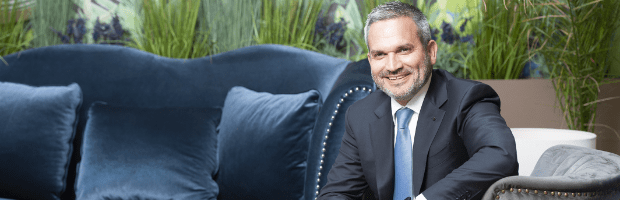
It’s interesting how you can find subtle similarities and common threads in the lives of people who’ve taken very different paths. I think I was under three when my father sold his Simpson motorcycle because the engine noise scared me. Ömer Tetik, the CEO of Banca Transilvania, gave up motorcycling when his first child was born; he’d bought his bike after seeing Easy Rider as a teenager — starring Dennis Hopper, an actor I had the chance to interview many years ago when he was in Bucharest.
Interview by Doru Iftime, Coordinating Editor, published by Forbes (September 2019)
Why did you choose a career in banking? Did anyone in your family work in the industry?
From the outside, banking can look a bit rigid and unwelcoming. What do you enjoy about your work? What gives you satisfaction?
It’s true, banking is about numbers — interest rates, metrics, financial returns. But everything around us is connected to a bank, to financing — whether it’s leasing, a loan or any other type of borrowing. I take pleasure in seeing our clients prosper and grow. I like to think we play our part in developing the business environment and helping Romanian entrepreneurship evolve.
One of the main directions for the bank you lead is supporting entrepreneurship. Are you personally tempted by entrepreneurship in any way?
My role at Banca Transilvania has a strong entrepreneurial component. That said, I don’t see myself starting a business right now. Even after six years at BT I still feel like it’s day one, and I’m energised by new projects and new client relationships. There’s still so much to do at BT and in the Romanian banking system that I believe my place is to contribute here. Maybe in 15-20 years I’ll think about a venture of my own. We’ll see. It’s about context — and about the courage of the moment.
How do you spend your free time?
My free time belongs to my family, so I try to make sure any spare moment goes to the kids and my wife. We have three young children — Aris is two, Selin seven and Deniz almost nine. They are my biggest source of energy. I travel a lot, I’m quite busy — and preoccupied — so I do my best to give the kids any free time I have. I love music, I like travelling with my family, I read — I try to read beyond business and management; I enjoy fiction, and my favourite authors include Neil Gaiman, Neal Stephenson, George Orwell and JK Rowling. I also find Yuval Harari fascinating. He became well known quickly with groundbreaking ideas that combine history with the future and anthropology with technology. I’m fascinated by his ability to explain very complex things in simple terms and bring them to a wide audience. Harari has, in a way, changed how we look at the future and at humanity today.
Tell me a bit about what you do together with your children.
We mainly try to spark their curiosity, identify their passions and help them build hobbies. We look for what they enjoy and do those things, rather than imposing our own choices. Deniz plays guitar and is good at basketball and football, Selin takes singing lessons, and they all swim… And Aris already dribbles very well — who knows, maybe he’ll be the first athlete in our family.
You said you’re busy and very focused on your work. There’s a lot of responsibility and pressure in what you do. How do you manage stress?
In principle, I focus on the positive. One thing is to talk about credit cards or consumer financing — it sounds very pragmatic — but it’s different when you say it’s about holiday gifts, buying a home or planning a vacation. On the other hand, I think stress has its role in achieving performance; you don’t get the same results if you’re completely relaxed. As a manager, I hope I manage not to pass the pressure or stress on to my colleagues.
You work with money. What does money mean to you?
Twenty-five years ago, at the start of my career, money was a necessity. Today it’s a tool I can use to get things done. I like a quote I saw in the American edition of Forbes — money should be in your mind, not in your heart.
Do you have a business role model you admire? A person you look up to?
In business, I’ve been following and admiring Warren Buffett for a long time. At his age, he has amazing energy and a human, down-to-earth approach to problems, even though he manages hundreds of businesses in diverse industries all over the world. I always read about him and try to stay up to date with what the press writes. Closer to home, I have great respect for Mr Horia Ciorcilă (founder of Banca Transilvania, ed. note). I admire his tenacity, the way he chose the businesses he invested in, and the ethics and solid principles on which he has built his entire career. He is one of the architects of BT’s organizational culture — he has been with the bank throughout its 25-year history and has shown what a Romanian entrepreneurial success story looks like.
I know you like motorcycles. I read that you have a Fat Bob.
Motorcycling is one of my passions. I’d wanted a motorcycle since my teens, after I watched Easy Rider.
Fascinating you say that; I had the chance to interview Dennis Hopper many years ago.
Dennis Hopper was a very interesting man — not just an actor but also an art collector… So I’d wanted a bike for a long time and, when I had the chance, I bought one and customized it a bit.
Are you handy?
A bit. But when our first child was born, I said I had other responsibilities — I needed to be more careful, to take care of myself and my family — so I sold the bike. A few years later I changed my mind. It’s a passion I share with my wife, and she encouraged me — she said I deserved a bit of a treat after all that work. So now I have a Fat Bob. I regret not having time to ride it as much as I’d like, but sometimes it’s enough just knowing it’s there. And a ride, even a short one, is always a pleasure. In Transylvania, the scenery is spectacular; in Bucharest, on the other hand, it’s not exactly a pleasure to drive — car or motorcycle.
Drivers don’t tend to pay much attention to motorcyclists.
It’s a learning curve — there are more motorcycles and scooters on the road, and drivers still need to get used to them. A good rule I learned in traffic, backed by sociological research, is that as people and as drivers we’re not used to seeing what we’re not looking for. In other words, we more easily see what we’re scanning for. When you’re driving and check the side or rear-view mirror, you’re looking for a car — not a biker. In summer, it’s good to look out for a motorcycle or a scooter as well.
Car or motorcycle — which do you prefer?
I prefer the motorcycle, but the car is more practical, at least in Bucharest where the weather can be changeable. Winter isn’t for biking, summer is too hot… I think I use the scooter more often — I can ride it to the bank in a suit.
I like that image. Would it be fair to say you’re a fan of the American auto and motorcycle industry?
At least until 2000, the American auto industry focused on power rather than comfort and handling. Cars were simple and you could do basic fixes as an amateur; you didn’t necessarily have to go to a service shop. If you want comfort and lots of buttons, you get a European car. I prefer American cars because you develop a friendship with them. You stay loyal, you keep them — you don’t become a consumer. And the sound of a V8 is addictive — it’s amazing.
If you could make a wish…? Something you’d like to do but haven’t yet managed?
I’d like to take a long trip with my family, in a motorhome.
In a motorhome or towing a trailer?
In a motorhome. Somewhere around the Mediterranean. But a few conditions need to be met: it would have to be a trip of a few months, the kids should be a bit older so they’re left with great memories… And I’d need to be less busy so I can be away from work that long. Right now it seems impossible. In a way, I think a trip like that is worth it just to debunk some preconceptions: when we corporates are stressed, we think Greece, Spain or Portugal are cure-alls. I say a two- to three-month trip will validate the idea that happiness is a good coffee or healthy relationships with friends and colleagues. Maybe it is, maybe it isn’t. But it’s worth trying.
A character trait you have that you’d like to pass on to your children.
Respect for others — that’s what I learned from my parents. Always think of others too, consider their position and respect it. Always be mindful of the impact your actions, ideas or attitudes have on them — on the people around you.
If you had to start over, would you choose the same path? Would you change anything?
That’s a tough one. I consider myself lucky — I have a wonderful family, three children, a wife I love, a job I do with pleasure and passion… I’d be afraid to think about changing anything; a different path would probably mean I wouldn’t be where I am today. So I’d rather say I’d repeat past mistakes to end up where I am now.