BT’s products and services are designed with trends, customer needs and lifestyles in mind.
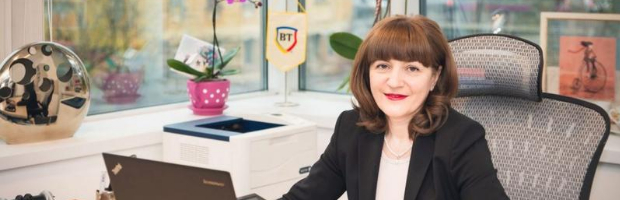
Gabriela Nistor, Deputy CEO, Retail Banking, BT, recently gave an interview to the online publication Banking News on lending trends and the outlook for 2022. We’re reproducing the full interview below—enjoy! 😊
How are retail banking products and services changing in the wake of the pandemic, what do customers need in the new environment and how is Banca Transilvania responding to these challenges?
Products and services have to reflect trends, needs and lifestyle. What we saw in 2021 among our customers was the need for mobility in banking — remote banking, because that’s the way the world works now — for new functionality and for online security. Products are evolving either through upgrades or via digital versions, like cards, which today can be not only in your wallet but also on your phone. That’s how we at BT have responded to the new challenges: with fresh ideas, adaptability, exemplary team mobilisation and investment in technology.
How ready are Romanians to adopt digital banking, how familiar are they with digital transformation and what measures are needed to accelerate digitalisation in Romania? What’s new at Banca Transilvania from this perspective?
Romanians have moved forward in this respect and, clearly, this is the way ahead, whether in banking or other sectors. Those most familiar with digital transformation are in the private sector, which set the tone years ago — teams that generate and contribute to recalibrating business models day in, day out. The population benefits from this transformation. For example, at BT, out of more than 3.2 million customers, over 2.5 million — almost 70% — are digital. By this I mean both individuals and companies. What does that mean? They use at least one of the bank’s digital solutions — either mobile apps or Internet Banking. In 2021 we continued to roll out solutions for remote banking, most of them linked to BT Pay. These include the ability to obtain the Star Forte credit card 100% digitally in about 10 minutes through the app; the launch of bill payments via BT Pay; and payments through Alias Pay, which lets our customers make payments using a mobile phone number instead of an IBAN. As for Romania’s digitalisation, fortunately companies were on this path many years before the pandemic, and the pandemic only accelerated digitalisation in the private sector. It pushed companies to look for new solutions to fit the context. All our appreciation, as the bank for enterprising people, to the entrepreneurs who understood that digital transformation can help relaunch a business or support sustainable growth. We also see the public sector contributing more and more, by digitalising processes — which will not only make interactions easier, but will be essential to raising Romania’s overall level of digitalisation. A major contribution can also come from narrowing the digital divide between urban and rural areas, as well as from digital education and developing the relevant skills. Romania’s paradox is that, although we have a large number of IT graduates and are in the EU’s top five on this metric, we still face a shortage, which limits the capacity to fully benefit from digital transformation.
How has retail lending evolved in Banca Transilvania’s portfolio and what are your expectations for the period ahead? What impact will higher interest rates, rising inflation, the energy crisis and political instability have on the bank’s retail activity? What options do borrowers have if they run into difficulties with loan repayments in the period ahead, given a less-than-optimistic outlook? How does Banca Transilvania view savings and how has the deposit portfolio evolved?
Looking at BT’s figures for January–November 2021, people kept making plans — and that makes us optimistic. Concretely, loans granted were up by more than 60% versus 2020. As for the outstanding balance of loans to individuals, here too we saw growth: +12% compared with November 2020. For 2022 we expect the retail lending cycle to continue at a solid annual pace. There are favourable prospects for productive investment, with positive implications for the labour market. From what we see, at system level we estimate retail lending will grow by over 9% in 2022. For customers who are facing personal issues that affect their ability to pay instalments, our bank can offer loan restructuring solutions such as rescheduling the outstanding balance over a longer term or temporarily reducing the monthly payment obligation. Those customers should contact the bank as soon as possible so we can find solutions together and avoid the build-up of arrears. On savings, term deposit balances posted moderate year-on-year growth, in line with the market. Banca Transilvania encourages both the classic savings model through term deposits and alternatives via the range of investment funds offered through BT Asset Management. In addition, through BT Capital Partners we are among the participants in the Ministry of Finance’s government bond offerings.
What are your expectations for the risks that feed into the cost of borrowing for households in Romania? How do you see 2022 unfolding from a risk perspective, and how will financing costs evolve in the local market given the uncertainties and risks weighing on the economy?
If we look at interest and risk — the components of the cost of financing — we can also outline our estimates. Over the past six months we have seen an upward trend in financing costs — I mean interest rates and government bond yields — and this will lead to higher costs for customers. We hope, however, that this will be a short‑term trend. As for risk, it’s hard to anticipate its effect on financing costs, but we hope it will hold steady, even though property purchase prices have risen quite sharply recently.
The coronavirus pandemic did not cause a credit freeze — on the contrary, mortgage lending performed far above even the most optimistic expectations. How do you view this acceleration in mortgage lending over the past year and a half and what was behind the buoyant market? What impact will the health crisis have, what needs did it create among the population and how will this change mortgage lending in the coming years? What is the status of Banca Transilvania’s mortgage portfolio and what are your objectives for the period ahead?
Mortgage lending continued on an upward trend even after the onset of the health crisis. The evolution was supported by the government-backed Prima Casa/New Home programme, as well as by low real financing costs. The swift recovery of the economy and a positive backdrop in financial markets also contributed. At Banca Transilvania, at end-November 2021 the stock of mortgage loans, including Prima/New Home, was up 15% versus the end of 2020. For next year we are targeting a trajectory similar to that estimated for the banking system. However, it is difficult to anticipate what the post‑pandemic world will look like — or even when it will begin.
What is the profile of customers who have taken out a home loan — income, down payment, loan size, type of interest rate? What kind of homes are they choosing and which areas (cities) show the strongest demand?
In general, those taking out a home loan are 35–40 years old, have income of around 5,000 lei, are married, university educated and work in the private sector. The average down payment is 24% and corresponds to collateral consisting of a two-room apartment in an urban area. As for the areas with the most such loans, the ranking is: Bucuresti, Cluj, Timis, Constanta and Iasi.
What advice do you have for Romanians considering a home loan? What elements should they analyse to gauge whether they are ready for this step? What product features should they look at when choosing a loan?
Buying a home is certainly an achievement and we all dream of that moment, especially since we Romanians have a strong sense of ownership. And because having your own place is part of our upbringing, it’s a milestone, a sign of fulfilment and stability. That said, these are the longest‑tenor loans, stretching over many years during which there can be ups and downs — so the decision needs to be weighed very carefully; it has to be a responsible one. Each instalment should be seen as a contribution toward that property, and the bank as a partner in making that dream happen. If I were to offer a few tips on what to look at when considering a mortgage, I would point to the Annual Percentage Rate (APR). For a like‑for‑like comparison, it’s important to keep the amount and tenor the same. The total cost of the loan matters — especially over decades — but it’s also worth considering: how quickly the loan can be obtained; the minimum monthly payment; the property insurance component; early repayment with no fees; and the relationship you have with the bank — it’s a plus if you are already a customer. Last but not least, customers should look ahead at things like income, the repayment amount, projections for their financial situation and their ability to repay early. Over 20–30 years a lot can happen, and you shouldn’t stretch beyond your means. For loans under the government programmes Prima Casa or New Home, guaranteed by the state through FNGCIMM, the main product features — price, down payment, maximum amount and currency — are regulated by law. As a result, banks have very little room to truly differentiate their offer. That’s why APRs for Prima Casa or New Home will be very similar from one bank to another.