Horia Ciorcilă: At BT, we have a united senior management team; it's something I care deeply about
In April 2025, Horia Ciorcilă, Chairman of the Board of Directors of Banca Transilvania, gave an interview to Ziarul Financiar, Banca Transilvania will keep growing because there is still room, which is reproduced in full below:
Leaving aside the financial results, how was 2024 — what went well, what less so, and how did the economy and business fare?
Fundamentally, 2024 was a good year for the BT Group. Beyond the financials, we managed to consolidate our leadership in banking and strengthen the financial group’s structure. Our scale works to our advantage in many respects, and at the same time our constant focus is on efficiency. Growing a bank is like raising a child: you have to adapt, because each stage brings a new dimension. The bank is young yet mature at the same time, with lessons learned, experience, and — above all — the courage to take the next steps.
One of the bank’s great strengths is its team — highly experienced, loyal and strong. Likewise, we have a united top management team, which I value greatly.
As for Romania’s economy, it has grown significantly in recent years and is now in the most favourable position in our history. Even so, against the backdrop of the pandemic, developments in Europe and the geopolitical context, some deficits have built up that are now falling due and must be tackled with pragmatic, targeted solutions. I’m referring especially to the budget deficit, for which there is both context and circumstance. Of course, the trade deficit also has structural causes: we consume more because we tend to aim for the same standard of living as in the West, but domestic production has not kept pace. That can be addressed only through substantial investment from domestic sources, including banks, as well as EU funds. In 2024 certain peaks were reached in this respect, and addressing them has now become urgent.
Which markets or areas did BT gain or lose ground in?
BT significantly strengthened its market position in 2024, and the other BT Group companies did as well, growing both organically and through business acquisitions. We support all of Romania’s strategic sectors — such as energy, healthcare, agriculture, road infrastructure, trade, manufacturing, services and transport — to help boost Romania’s competitiveness, underpin a resilient economy and narrow the gap with the West. In terms of business, we are seeing very strong results on the large corporate side — for us, clients with over EUR 50 million in turnover — where we are growing fast and are the lead financier for the entire corporate ecosystem in Romania.
Another area where we grew and where we’ll keep up the pace in 2025 is the premium client segment, which today numbers about 150,000 clients — roughly 4% of our retail customer base. The wealth and prosperity of Romanians have increased in recent years, so this niche is far more substantial — people working in large companies, entrepreneurs, specialists, doctors or architects, for example — with above-average incomes. We launched products for them in 2024 and we are rapidly gaining market share.
Separately, Bucharest — the market with the highest potential in Romania — is a place where we are growing across the board. We need to stay on this trajectory to get as close as possible to the market share and pull we have at national level.
How is BT positioned on the corporate side, and what was the objective for 2024?
Large corporates were one of BT’s best-performing business areas in 2024. We finance everything from entrepreneurial businesses to multinationals, which for us means backing key industries, trade flows and the Romanian economy. Large Romanian and international companies have the greatest power to change Romania because they have the capital for major investments in technology, infrastructure and development.
Last year, compared with 2023, we significantly exceeded our target in this client niche. On lending, we posted 23% growth. We now have a very strong and balanced position across all our business segments — retail, SMEs and large corporates. There is still room to grow in certain areas, but we are well positioned on all the main segments and have ambitious plans for each of them.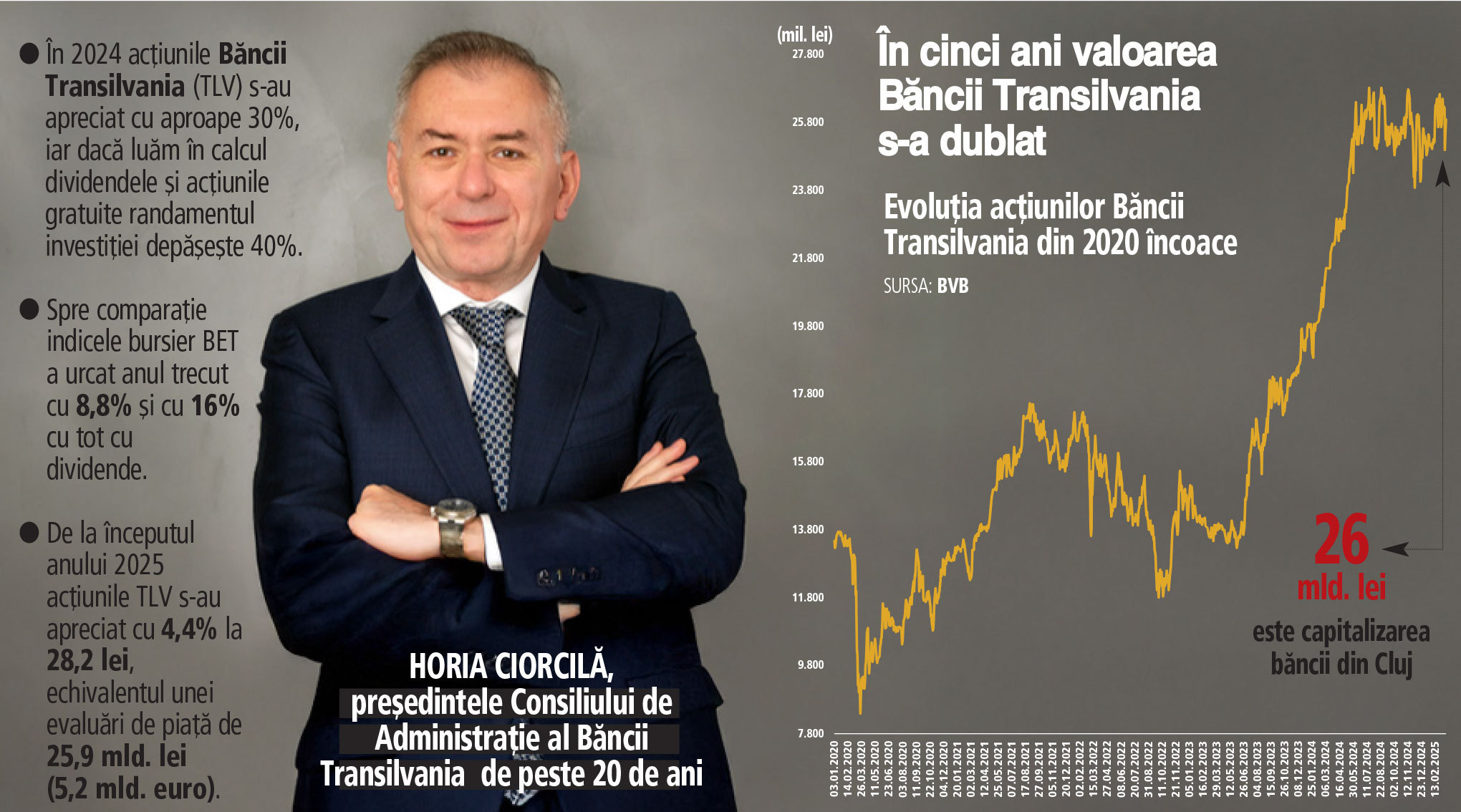 What is your message — and BT’s message — to shareholders?
I want to thank our shareholders for their trust in the bank, in our plans and in our top management. We do everything in our power to deliver positive results so that shareholders benefit from the growth of the bank and the Banca Transilvania Group.
Just a few days ago we held BT’s general meeting of shareholders, where shareholders approved a very balanced profit allocation. About 55% of profit goes to reserves and to strengthening BT’s capital base, while 45% goes to shareholders. By its nature and given strict regulation, banking requires a lot of capital to finance growth in lending and to support the economy. As a result, a large share of our profit is capitalised, which allows us to increase the financing we provide and grow the business.
What does the shareholder structure look like? Is BT seeking greater diversification and a broader investor base?
BT’s shareholder structure is a point of pride for me — both in terms of the share of Romanian capital and the growing number of shareholders. Almost 80% of our capital is Romanian. Romanian pension funds own around 26% of Banca Transilvania, which effectively adds some 8 million indirect shareholders — the participants in those funds. Over 67,000 shareholders — individuals and investment funds from all over the world — invest in TLV shares. To give you a sense of the bank’s appeal, last year we welcomed more than 15,000 new shareholders, double the number in 2023.
Investment bank funds from around the world contact us or regularly ask for information about BT’s plans and performance, seeing Banca Transilvania as an investment opportunity — which is very encouraging. When we placed bonds on the market, a significant number of international funds committed substantial amounts. With new categories of investors interested in the bank’s shares and bonds, and with positive results, we expand this virtuous circle of growth: we build capital, which we then use to finance Romania, the government and households.
Which sectors does BT allocate — or plan to allocate — more capital to?
Through the large corporate segment, via which we provide our biggest financings, in 2024 and the first months of this year we supported Romania’s key strategic sectors — healthcare, agriculture, energy efficiency and renewable energy generation. For this year we have two strategic directions on the corporate side. The first is loan syndications, where the bank has contributed expertise to a large number of transactions. The second is supply chain finance, for which Banca Transilvania offers solutions that benefit SMEs.
In practice, we help entrepreneurs manage market volatility, grow their businesses and adapt their operating models so they can be better integrated into Europe’s entrepreneurial ecosystem. In parallel, we are investing consistently across all segments, precisely because we are expanding and targeting growth. We are investing in retail, where we have a very strong position; in SMEs, where we have absolute leadership; and in large corporates, where we see significant potential. These investments go hand in hand and reinforce each other through synergies. When we finance a large client, we support the entire ecosystem around it — from SME partners to employees. In many cases, that’s how we start doing business with — or financing — the wider ecosystem.
What has BT gained from the OTP Bank Romania acquisition — in terms of business, clients and market share?
The acquisition of OTP Bank Romania was a very good move. It helped consolidate the bank’s leadership position. BT reached a 23% market share, and the actual gain from the acquisition was 683 million lei. The deal also brought us around 150,000 clients, a 9% increase in assets and a 13–15% increase in the loan book, as well as a stronger presence in Bucharest and in central Romania. We have very good client retention from OTP Bank Romania — over 90% — both corporate and retail.
The acquisition was also a good deployment of BT’s resources and liquidity, given that we had more deposits than loans while at OTP Bank Romania it was the other way around. Of course, it was another opportunity for the team, given our strong capability to execute integrations quickly and successfully, in parallel with organic business growth.
As with any such project, it came with challenges — especially because of the fast integration, in just seven months — but we accelerated everything in favour of OTP Bank Romania’s clients, to keep any inconvenience to a minimum.
How does BT assess business risk in the economy now, given domestic tensions? What level of risk can the bank take on, as the largest financier of the economy?
Romania’s economy has significant growth potential. We’ve moved closer to the EU average, but there is still room to grow. Let’s not forget there are major differences between regions and we need to help even them out. That requires investment and capital. The gap is understandable — in the West, capital accumulated over hundreds of years, whereas in Romania we more or less started from scratch 35 years ago. But we are optimistic and moving forward with confidence.
In the long term we see growth, but it will not be linear — there will be turbulence and adjustments will be needed. One example: mathematically and sustainably, we cannot have such a big gap between government spending and revenue in the long run.
We pay very close attention to all risks, but we are also very well prepared, because we have substantial capital buffers and scale on our side. Moreover, the last few years have taught us a lot about resilience and the importance of reacting quickly. Deficits need to be adjusted gradually, because any attempt at adjustment can create shocks in the economy — possibly social reactions as well. Taxes need to stay at a reasonable level — both because in some areas they are already high, because we need to remain attractive to capital, and because we have a productivity gap versus the West.
What are BT’s objectives and plans for moving from a traditional bank to a more digital one?
I believe that nowadays there is very little point talking about “traditional” banks, because banking has been one of the industries investing most in technology, totally transforming how clients do their banking. BT is a universal bank — for everyone — whether they prefer to bank on their phone or to come and see us, with a major digital component. We have one of the largest branch networks in Romania — we’re present in roughly 180 locations through more than 530 branches — and we also have flagship apps such as BT Pay and BT Go, a state-of-the-art core banking system, artificial intelligence integrated into services, chatbots and automated processes. This hybrid model fits best given our very large client base — almost 5 million — and it greatly facilitates financial inclusion. Diversification is welcome, because it increases our addressability and accessibility and, on the other hand, reduces market risk.
We have made significant technology investments, especially in recent years, and we’ll keep that approach going forward. This is clearly where the future lies. Technology helps us process millions of transactions every day and be, in effect, the backbone through which Romania’s transactions and money flow. But we don’t want to limit ourselves in terms of distribution. We want — at the same time — to have the best apps and the best branch network in Romania. This is part of BT’s vertical integration plan, so we have full control over the client relationship thanks to our apps, extensive branch network, ATMs and cash processing solutions.
What are the BT Group’s plans in leasing, asset management and insurance brokerage?
BT Asset Management’s objective is to surpass 7 billion lei in assets and 400,000 investment accounts. We are on track thanks to very strong growth in both assets and the client base. We’re pleased that a very large number of investors — more than half of BT AM clients — have set up long-term savings plans based on recurring investments.
As for BT Capital Partners, it started the year from the position earned last year as the largest broker on the Bucharest Stock Exchange, and we want to keep it. There have been two historic years on the Bucharest Stock Exchange (BVB), with equity listings and bond issues, and ambitions remain high on profitability, where we are above budget targets for the first quarter. The client base has grown to a record level and trades on international markets are making a significant contribution, up more than 60% versus last year’s average. Leasing has also grown very nicely. This year we are focusing on consolidating our position along three main directions: organic growth, digitalisation and expanding strategic partnerships. On insurance brokerage, we recently announced a new CEO and our plan to diversify BT Broker de Asigurare’s business model — transforming the company from a niche broker, specialising in motor insurance where we are leaders, into a universal broker.
What does BT do with its surplus liquidity, given that deposits exceed loans?
Banca Transilvania’s role and objective are to finance the economy and use capital efficiently, so we can pay attractive rates on deposits and offer loans at the lowest possible cost. This matters because, for a country or a company, low funding costs are a competitive advantage. So we want to lend to as many companies and individuals as possible but, because we are using capital and depositors’ money, we do so responsibly and are obliged to focus exclusively on bankable clients. All this allows us to pay good rates on deposits and, likewise, to offer loans at accessible costs. The result is seen in BT’s loan book growth, significantly above the market average. Of course, not every loan application is bankable — not every company that approaches us for financing fits within policy and regulatory parameters. There are other challenges too, some specific to Romania, such as the high number of small or undercapitalised companies.
We direct surplus liquidity to safe — or as safe as possible — investments such as Romanian government securities. And foreign currency liquidity we hold on behalf of clients can be placed in bonds or other instruments issued by Romanian companies or foreign banks. We have substantial surplus liquidity, which gives us room to manoeuvre and flexibility when we see opportunities.
What is the next big objective for Banca Transilvania?
Growth, consolidation, a focus on the diaspora, and caring deeply for our clients. There is still room for the bank to gain a few more percentage points of market share, as well as to consolidate BT Group companies. On the diaspora, we are looking very closely at Romanians everywhere, and through our apps we can offer banking solutions for Romanians wherever they are. Today, roughly 14% of BT’s clients are Romanians living abroad. Italy has a special place for us, as we have had a physical presence in Rome for 11 years. For our Romanians there, we recently launched BT Pay Italia, which will accelerate the financial connectivity of family members in Romania and Italy. Our goal is for one in four Romanians living in Italy to bank through BT Pay Italia. Beyond targets, if Romania does well, Banca Transilvania does well.