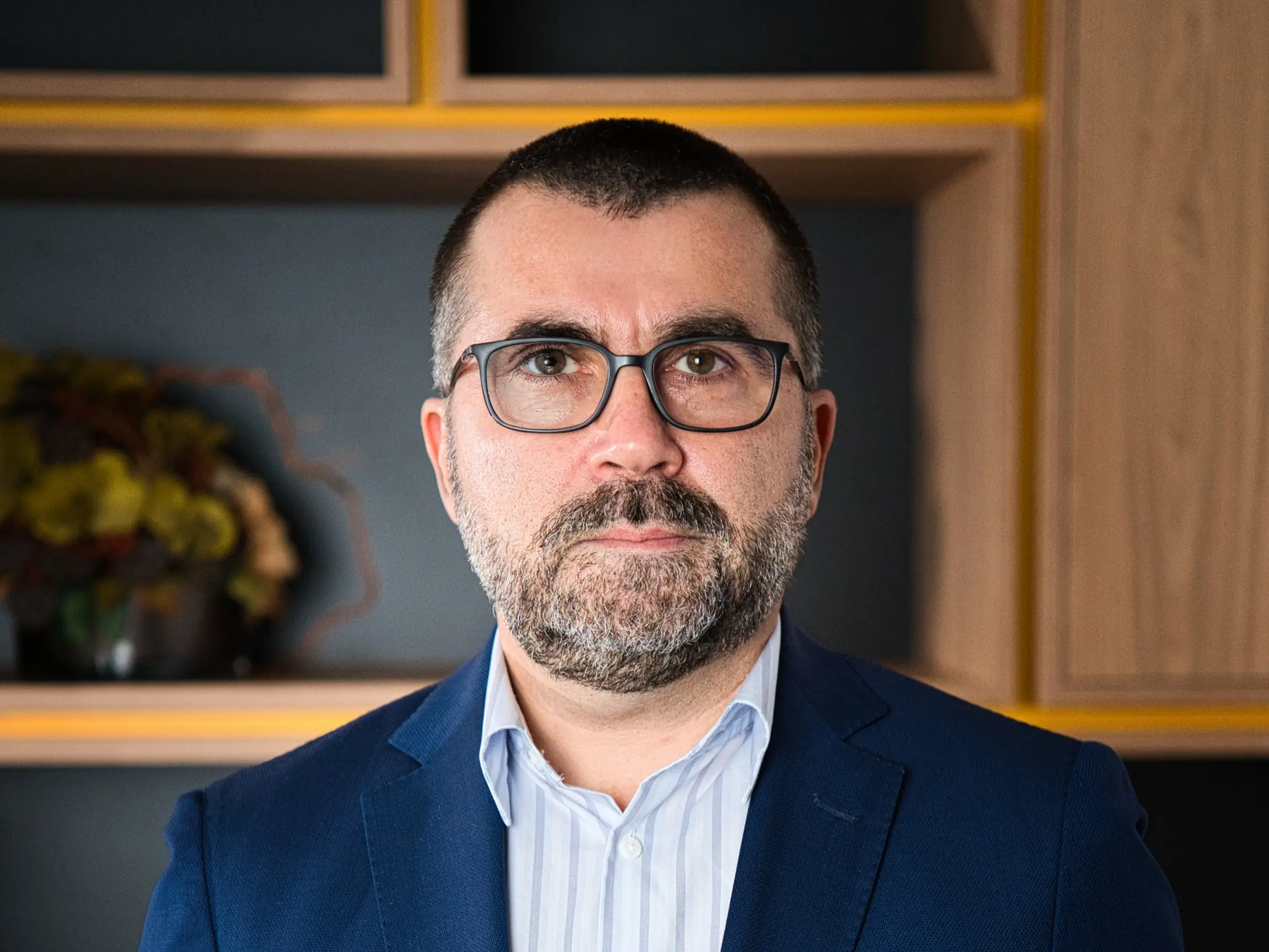
Ömer Tetik: "Romania can become an attractive destination for investment"
23 for 2023, an editorial project by Forbes România, is a series of articles in which 23 leaders assess the economic backdrop for the current year.
The BT voice: Ömer Tetik, CEO, Banca Transilvania. Here is the interview he gave Forbes România.
...
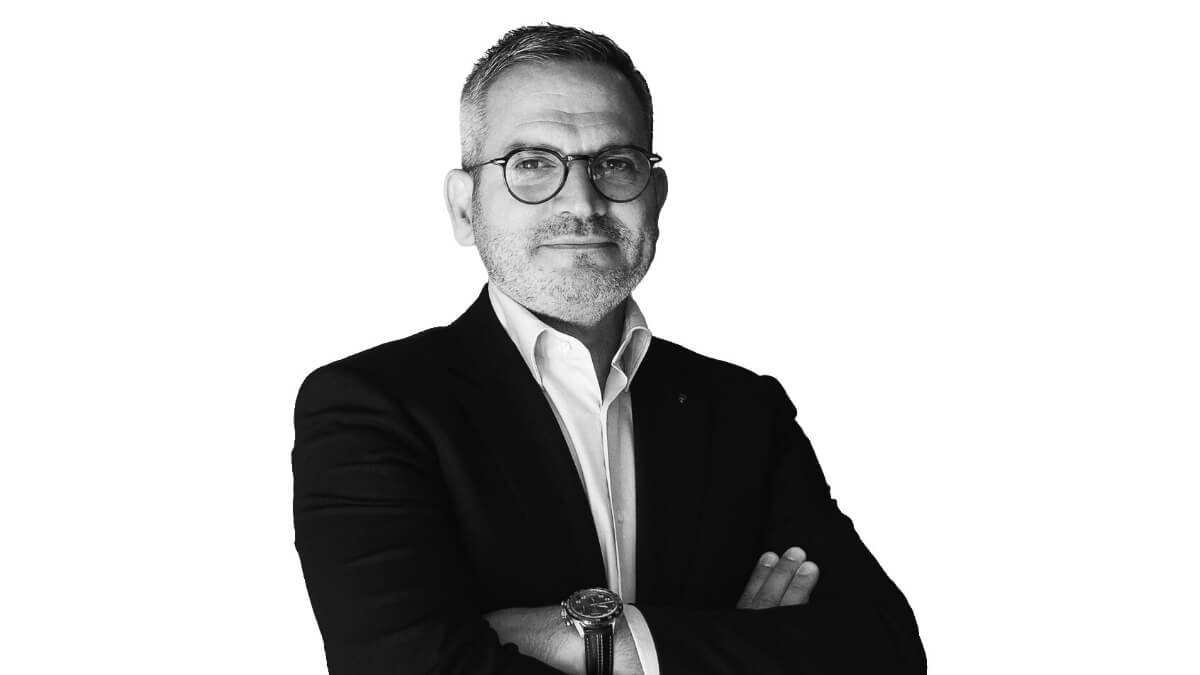
Ömer Tetik, CEO of Banca Transilvania, took Banca Transilvania to No. 1 in his first decade at the helm, and now, in the toughest economic context in recent history, needs to set the best strategy for the period ahead.
The discussion with the most influential executive in banking took place at STUP, a EUR 3 million Banca Transilvania project dedicated to supporting entrepreneurial businesses, located in the capital’s south-central area, right next to Parcul Tineretului, the largest green space in the city. And, just like in a beehive, hundreds of people were buzzing around the 2,500 square meters laid out over two levels.
One week everyone is upbeat, then some “bad news” hits and people change their perspective. That’s why I say we should move like penguins, with small but sure steps, says Ömer Tetik, just out of an event — not one of the dozens of projects organized for the small entrepreneurs in the STUP community, but one dedicated to BT teams.
23 for 2023 Dossier. Where are business and society in Romania headed?
Our meeting coincided with a large-scale annual test of the bank’s IT systems, which went well. “Essentially, you test whether you can shut down all systems and switch to plan B. So far everything is fine, the system works. Such an exercise is necessary because you can’t have a business continuity plan if your systems don’t work, and if on top of that you get inflation, a war breaks out, and so on… We are the generation that has lived through, or heard from our parents about, hardships, but our children or half my colleagues have seen only growth, only improvement in their lifetimes,” says Ömer Tetik, who recalls his teenage years in Turkey, with drastic limitations on electricity availability or the TV schedule — a very familiar memory for Romanians now over 40 as well.
The problem is that European politicians are the same. They haven’t lived through such times either (…) Earlier I spoke with Virgil Stănescu (a former professional athlete, regarded as one of the best Romanian basketball players – Ed.) and he said that difficult situations must be part of an athlete’s training because he needs to have plays ready for any situation. I think it should be the same in business, in politics and in life in general, adds the man who has led Banca Transilvania for nearly ten years.
Ömer Tetik was recruited by Horia Ciorcilă, chairman of BT’s Board of Directors and one of the founders of Banca Transilvania, at a time when the bank ranked third in the local market, with assets of around RON 30 billion and a market capitalization of nearly RON 3 billion. They have worked — and continue to work — in perfect tandem. Banca Transilvania has grown rapidly, both organically and through major acquisitions, becoming the leader of the local banking market, with assets over RON 140 billion, according to the latest reports, and a market capitalization of over RON 14 billion at the time of writing.
In addition, Banca Transilvania is one of the main financiers of the Romanian state and holds a portfolio of RON 40 billion in government securities, whose value has fallen sharply lately as an explosive bout of inflation has driven yields on government securities sharply higher.
Today, banks are paying over 8% on deposits while earning 2%–3% on government securities bought several years ago. It’s both a real cost and an opportunity cost — one that weighs on bank balance sheets and on the real economy, because many billions are being siphoned out of banks’ actual lending capacity, money that could otherwise have gone to finance companies and the wider economy.
BT — like all banks, in general — has a large exposure to the state, which is why we keep insisting that the state be careful how public money is spent. We focus on the efficiency and impact of that spending.
This year should be one of the most important in the banker’s career also because of the largest bond issue announced so far by a company in Romania.
We announced last year that we will do a bond issue, in the context of the capital requirements in the market. We’re doing it precisely because we want the capacity to finance the economy and Romanians, and for that we need a strong, diversified capital base. We also have solid capitalization, which gives us the comfort to decide the timing of our market entry; we’ll go out when the yield and financing conditions are best for us.
Banca Transilvania’s shareholders approved last autumn a general framework for issuing bonds of up to EUR 1 billion, via separate issues over a period of up to ten years, to meet MREL (Minimum Requirement for Own Funds and Eligible Liabilities) and to finance the economy and households. In practice, European standards require banks to maintain at all times an optimal level of MREL-eligible funds, which do not include customer deposits, guaranteed by the Bank Deposit Guarantee Fund. The instruments will be unsecured and will not be convertible at investors’ initiative.
It’s both an advantage and a disadvantage. It’s our first such transaction, and the first of this size in Romania. It will be listed abroad as well. There’s strong interest — investment banks and funds have started calling us. That’s fine, but on the other hand, being the first, it will involve a process with far more questions and effort on market sounding and the roadshow, says Ömer Tetik, without giving further details.
In its history, Banca Transilvania has raised capital, among other ways, by attracting direct placements from international institutions such as the EBRD, as well as by capitalizing profits. In just the past decade, Banca Transilvania has capitalized more than RON 5 billion of profits to support the rapid growth that has made it the leader of the banking market. That means BT has reinvested its profits precisely to be able to support Romania’s development.
What, then, is the biggest risk that could affect the economy and, with it, Banca Transilvania’s trajectory?
Maybe the top bosses at investment banks or economists aren’t used to inflation this high, but we’ve seen it before. For us, the biggest concern now is how the state will behave. I’m not necessarily talking about infrastructure investment. I’m also thinking that, as a country, we have fairly large expenditures and need to ensure that this spending is efficient and that a significant percentage goes into investment, adds Ömer Tetik, who raises questions about the sustainability of the debt level if it is not used appropriately.
Second, the banker warns about how the main economic agents — from banks and ANAF to large companies — will handle debts and receivables.
If any of these players starts demanding money back quickly, or delays passing money on, we’ll get into the same downward spiral as in 2009. That will increase insolvencies; people will stop paying. If you and I both have loans but are struggling, and I tell you I’m making an effort to pay, you’ll probably make an effort too. But if I tell you I don’t want to pay, then you also have an argument for non-payment, the banker adds, who also cites Romania’s demographics and inflation among the risks.
In Romania we’re to some extent used to inflation. Still, I think it’s better to have some stability than a very low inflation that discourages investment and transactions — better to have 10% inflation and be able to adapt, make medium-term plans every year, but know it’s 10%, than to go from 2%–3% to 16% in a short time and then drop to 10%, concludes the head of Banca Transilvania, who realistically believes that the problems at the border can also be an opportunity for Romania. Romania has energy resources, agriculture, and so on, and can become an attractive place for investment, as well as a hub for Ukraine’s reconstruction.