Save the Children Romania, Mastercard and Banca Transilvania will help improve medical care for more than 4,000 newborns each year
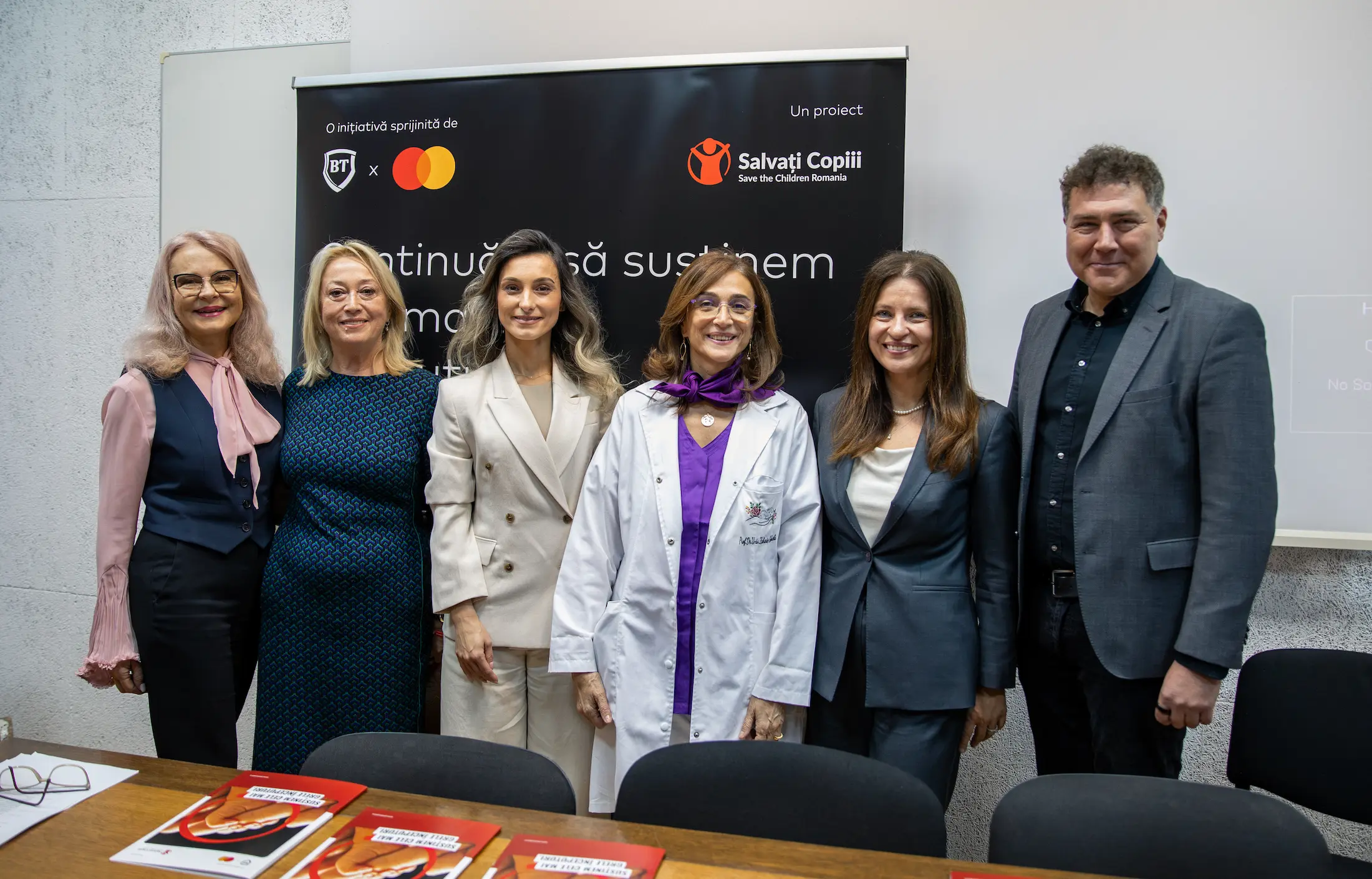
One year on from launch, the “Susținem cele mai grele începuturi” program is supporting equipment for seven medical facilities, the upgrade of five neonatal follow-up centers and the development of a digital platform for monitoring children.
- Five follow-up centers for preterm and high-risk newborns have been upgraded and equipped to assess and track children’s progress after discharge from the maternity hospital.
- Seven medical facilities received support for purchasing equipment and carrying out renovation works. The donated equipment is expected to help care for over 4,000 newborns each year.
- A digital platform dedicated to neonatal monitoring is under development. It will enable tracking children’s development in the first 24 months of life and help families follow the recommended schedule of medical assessments.
- Approximately 100 healthcare professionals will benefit from continuing training courses, including on communicating complex diagnoses to parents.
Salvați Copiii România, Mastercard and Banca Transilvania are helping improve neonatal care through the “Susținem cele mai grele începuturi” program. One year after launch, the program has supported the upgrade and equipping of five follow-up centers for preterm and high-risk newborns, as well as the purchase of medical equipment and renovation works in seven healthcare facilities. The donated equipment is estimated to help care for over 4,000 newborns annually, and the five centers will be able to monitor around 1,000 high-risk children each year. The program also includes development of a digital platform for post-discharge monitoring, as well as continuing training courses for approximately 100 healthcare professionals.
“Preterm birth is a major challenge, and care for these children does not end when they leave the maternity hospital. Through the ‘Susținem cele mai grele începuturi’ project, together with Mastercard and Banca Transilvania, we aim to help improve care for preterm newborns by equipping medical facilities, providing continuing training for staff and supporting the monitoring of children after discharge. Every child deserves the best possible start in life, and access to appropriate care and follow-up services can make a real difference to their health and development. Investing in neonatal health means investing in children’s future,” said Gabriela Alexandrescu, Președinte Executiv, Organizația Salvați Copiii România.
How the program is improving neonatal care across seven medical facilities in Romania
The program focuses on three complementary areas: upgrading and equipping maternity units, digitizing post-discharge monitoring, and continuing training for medical staff.
The equipment and renovation works address needs identified in each of the seven beneficiary medical facilities:
- Spitalul Clinic Județean de Urgență Cluj-Napoca, Neonatology Departments I and II: one ultrasound system, two ventilators, a neonatal resuscitation platform to monitor the umbilical cord clamping procedure, two positioning kits for preterm infants, and an ultrasound software upgrade;
- Spitalul Municipal Gherla: five newborn cots, a pulse oximeter and a syringe pump;
- Institutul Național pentru Sănătatea Mamei și Copilului „Alessandrescu-Rusescu”, Polizu Maternity, Bucharest: three complete laryngoscopy sets, professional medical cabinets for safe medicine storage, an aEEG monitor and specialized furniture;
- Spitalul Clinic de Obstetrică-Ginecologie „Cuza Vodă”, Iași: one ultrasound system;
- Spitalul Clinic Municipal de Urgență Timișoara: a vein visualization device and equipment for monitoring newborns;
- Spitalul Clinic de Urgență pentru Copii „Louis Țurcanu”, Timișoara: modernization of the pediatric orthopedics department;
- Spitalul Clinic Județean de Urgență Târgu Mureș: a washer-disinfector for baby bottles and a ventilator.
“Behind the figures are people — children, parents and doctors for whom every detail matters. Over 4,000 newborns means over 4,000 new beginnings and thousands of families for whom the first days or months bring emotions no statistic can capture. It means days when you celebrate every step forward, however small. It also means doctors who need equipment, conditions and the right resources to do everything possible for every child. This is how solidarity turns into tangible support, and impact means life,” said Oana Ilaș, Deputy CEO, Retail Banking, Banca Transilvania, and BT sponsor of the “Susținem cele mai grele începuturi” cause.
Where the five neonatal follow-up centers are located
The five follow-up centers operate within the following medical facilities:
- Spitalul Clinic Județean de Urgență Cluj-Napoca – Neonatology Department I;
- Institutul Național pentru Sănătatea Mamei și Copilului „Alessandrescu-Rusescu” – Polizu Maternity, Bucharest;
- Spitalul Clinic de Obstetrică-Ginecologie „Cuza Vodă”, Iași;
- Spitalul Clinic Municipal de Urgență Timișoara;
- Spitalul Clinic Județean de Urgență Târgu Mureș.
The centers have undergone renovations and received equipment according to each facility’s needs. Where required, works included replacing windows and doors, renewing flooring and upgrading restrooms. The centers were also fitted with specialized furniture and medical equipment. All purchases were tailored to each center’s requirements.
The follow-up program, also known as neonatal follow-up, covers the period from discharge from the maternity hospital until the corrected age of two. In some cases, monitoring may continue into school age, between five and seven years, to assess cognitive functions, language and attention.
The Romanian Neonatology Association’s national guideline on neonatal follow-up calls for such a program in every level III center. In practice, developing it requires action on three fronts: modernizing the medical spaces dedicated to monitoring, creating local specialist networks, and engaging families so that treatment and medical evaluations continue as recommended. These networks are designed to facilitate collaboration between existing specialists, including those who have not previously worked together.
“A child’s early months can have a significant impact on their development, and access to specialized care should not depend on where they are born. Through this partnership, we set out to help build a care framework that connects medical infrastructure, specialist expertise and the tools needed to monitor children after discharge. We are pleased to see concrete results and to be part of developing a model that can generate lasting impact for thousands of children and their families,” said Cosmin Vladimirescu, General Manager Mastercard România și Croația.
Another key component of the project is the development of a digital platform dedicated to neonatal monitoring. It will help doctors in the five centers track children’s progress and development during the first 24 months of life.
The platform is currently under development, with a first functional version expected by the end of November. Working sessions will also be held with representatives of each participating hospital. The digital tool will serve two main purposes: to help neonatologists centralize patient data and to encourage active parental involvement in keeping to the recommended schedule of consultations and monitoring for at-risk newborns. The digital monitoring model will be rolled out across all five centers.
How the program supports training for approximately 100 healthcare professionals
Continuing professional training is another core component of the program. Approximately 100 healthcare professionals will benefit from courses delivered by specialists and from educational materials tailored to participants’ needs.
Specific training needs have also been identified for nurses, including how to communicate diagnoses to parents, particularly in complex or difficult situations.
Why neonatal follow-up matters in Romania
According to Eurostat data for 2024, around 1 in 10 children born in Romania was born preterm, before 37 weeks of gestation.
Among countries with comparable data, Romania ranks among those with the highest shares of preterm births, with a value close to that recorded in Bulgaria (9.06%) and above the levels reported in Hungary (8.53%), Malta (7.36%) and Austria (6.86%). The lowest values in the dataset were recorded in Estonia (5.44%), Lithuania (5.49%) and Latvia (5.57%). The comparison includes only countries for which this indicator is available and does not represent a European Union average.
Inequalities in access to medical services are also a major issue. According to provisional data from the National Institute of Statistics for 2025, the national infant mortality rate was 6 deaths per 1,000 live births, compared with 6.2 per 1,000 live births in rural areas and 4.8 per 1,000 in urban areas. These differences highlight the importance of strengthening maternal and child health services and improving access to specialized care, regardless of where families live.
Preterm birth can be associated with a higher risk of medical complications and developmental difficulties. For children born preterm or with conditions requiring specialist supervision, regular evaluations after discharge can help identify developmental difficulties early and refer children to appropriate medical services or interventions.
***
About Organizația Salvați Copiii
For 36 years, Salvați Copiii România has been building social programs, public policies and robust practices for the benefit of children in Romania. The organization’s expertise and the scale of its nationwide projects make it an essential social institution whose role is to mediate between society and public authorities in the best interests of the child. Over more than three decades of activity, Salvați Copiii has intervened actively in society, identifying concrete solutions to protect and support vulnerable children, while advocating for effective collaboration with decision-making authorities to ensure the child’s best interests. Salvați Copiii has taken on a watchdog role over public authorities, ensuring that they implement lasting public policies that address the root causes of child vulnerability. At the same time, the organization has built active solidarity networks by encouraging the social responsibility of companies and society at large. As a member of Save the Children, the world’s largest independent organization promoting children’s rights, which has 30 members and runs programs in over 100 countries, our VISION is a world that respects every child’s right to survival, education, protection and participation, and our MISSION is to deliver meaningful progress in how children are treated and to bring about immediate and lasting change in their lives. More than 4,522,000 children have taken part in Salvați Copiii’s programs and campaigns.
For more information: Ștefania Mircea, project manager, email: stefania.mircea@salvaticopiii.ro, tel: 0745 375 148.
About Banca Transilvania
Banca Transilvania is the leader of the banking market in Romania and the largest bank in South-Eastern Europe. With a universal banking business model, it provides solutions to all customer segments and financial sector business lines. It has a 22% market share, over 5 million customers, approximately 10,000 employees, online banking solutions and 530 branches in 180 locations. BT plays an active role in Romania’s sustainable development, and its strategy is to generate a positive impact for people, the business environment and local communities.
Press contact: comunicare@btrl.ro.
About Mastercard
Mastercard powers economies and improves people’s lives in more than 200 countries and territories around the world. Together with our customers, we are building a sustainable economy in which everyone can thrive. We offer a diverse range of digital payment options, ensuring transactions are safe, simple, smart and accessible. Through our technology, innovation, partnerships and extensive networks, we provide a unique set of products and services that help people, businesses and governments reach their full potential.
www.mastercard.com
(1) Corrected age is the age of a child born preterm calculated from the due date at full term (40 weeks of gestation), rather than from the actual date of birth.
(2) Eurostat, Live births by birth weight and duration of gestation, link.
(3) Institutul Național de Statistică, Baza de date Tempo, link.