It seems we’ll come through the economic crisis more easily than we initially thought.
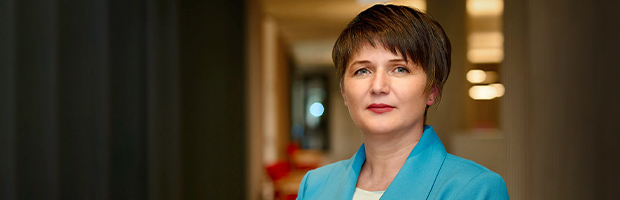
Luminita Runcan, Deputy CEO – Chief Risk Officer, speaks in an interview with Ziarul Financiar about economic risk, exchange rate and interest rate risk, and sector risks in 2021, noting that the economy and clients are weathering this crisis better.
The economy and clients are weathering this crisis better, and for clients who cannot yet resume loan repayments Banca Transilvania is preparing flexible restructuring solutions, says Luminita Runcan, Deputy CEO – Chief Risk Officer at Banca Transilvania, in an interview with ZF.
She says Banca Transilvania will continue to support the real economy according to its immediate needs, including by offering options to restructure credit facilities.
“At this point, it seems we will get through the economic crisis more easily than we initially thought, and we are optimistic — there will be realignments across various verticals of the economy. The trajectory of the national economy also depends on that of the economies of Western Europe, to which we are strongly connected. We hope the extension of the health crisis and restrictions in Europe will have manageable effects, limiting the indirect impact on Romania,” said Luminita Runcan, who has worked at Banca Transilvania for more than 25 years and has been Deputy CEO – Chief Risk Officer since 2014.
Speaking about the areas most exposed in the current context, BT’s head of risk notes that these are mainly cyclical industries and consumer discretionary. “If there is no sign of a recovery during this year, such sectors may remain heavily affected. In addition to those already mentioned, I would add retail in certain categories of goods.”
Banca Transilvania does not currently have sectors it refuses to finance, although it is clear that in those directly affected activity is in survival mode and investment is extremely low. “We are cautious in lending to such sectors, scrutinising the quality of the companies seeking financing.”
Against the backdrop of the negative effects of the COVID-19 pandemic, which left some retail and corporate clients unable to meet loan repayments, Banca Transilvania launched its own measures to support clients, supplementing the public moratorium by deferring instalments for some borrowers.
Referring to the expiry this year of the public moratorium on loan repayments, Luminita Runcan recalls that Banca Transilvania “will stand by its clients as it always has” and is preparing flexible restructuring solutions for clients who cannot resume repayments.
"We are preparing flexible restructuring solutions for loans, as well as financing for clients affected by the pandemic, precisely so that together we can support their recovery and the broader economic recovery. It is in everyone’s interest — the bank, clients, the economy as a whole — to benefit from facilities and understanding, which will help the recovery effort. Both in the past and now we are extremely attentive to this, and it has helped us in our relationship with affected clients and built our reputation as a responsible bank, open to dialogue"
Luminita Runcan also says that Banca Transilvania will continue to support the real economy according to its immediate needs, including through restructuring options for credit facilities so that they are both accessible and prudent.
As for exchange rate and interest rate risk, BT’s head of risk says she continues to expect “a moderate trajectory for both.”
“For 2021–2022, our specialists forecast a relatively stable environment, with interest rates edging down slightly. For clients with loans, that is very good news.”
Prudent cost management and higher business volumes helped Banca Transilvania, Romania’s largest bank, deliver a solid profit of about 1.2 billion lei and assets of over 103 billion lei in 2020, a year marked by the COVID-19 pandemic.
- Net loans outstanding increased in 2020 by 4.56% versus 2019, to 40.4 billion lei.
- At Banca Transilvania group level, total loans under management exceeded 42 billion lei.
- Luminita Runcan: We expect a moderate trajectory for exchange rates and interest rates. The current crisis is highly atypical.
ZF: How does Banca Transilvania assess exchange rate and interest rate risk? Is there a chance of the exchange rate rising, with an impact on clients and loan repayments?
Luminita Runcan: Exchange rates and interest rates have been, and will remain, in the market’s focus, given their abrupt moves during the 2008 financial crisis. As we have already seen, Romania’s economy is more mature than in 2008–2010, so the fluctuations we saw in the spring in exchange rates and interest rates were incomparably smaller. We continue to expect a moderate trajectory for both.
For 2021–2022, our specialists forecast a relatively stable environment, with interest rates edging down slightly. For clients with loans, that is very good news. The bank’s constant focus is to ensure a balance between interest earned on loans and interest paid on deposits, in order to maintain a responsible approach to all clients. Interest rates in our country are significantly better than in the rest of Europe. In this context, we note that 2020, in line with the last 10 years, brought an increase in savings, with deposits across the Romanian banking system continuing to grow.
ZF: What is the difference between the two crises?
Luminita Runcan: The current crisis is highly atypical. Its cause is one the modern economy has not faced in recent history, which is perhaps why the measures adopted by states and the economic environment may at first glance seem somewhat experimental.
Although it is hard to make a forecast, it is quite possible that the key difference between the two crises favours the current context, making today’s recovery much faster. In 2008, markets seized up and liquidity dried up, disrupting the flows needed for normal functioning. In 2020 it was a crisis exogenous to the banking system — a health crisis whose management measures negatively affected the economy and markets, by which I mean partial or full lockdowns.
Beyond the differences between the two moments, there are also similarities, the most important of which I would highlight: banks were at the centre of events, trying to respond to their clients’ needs and, alongside them, learning how to navigate the storm.