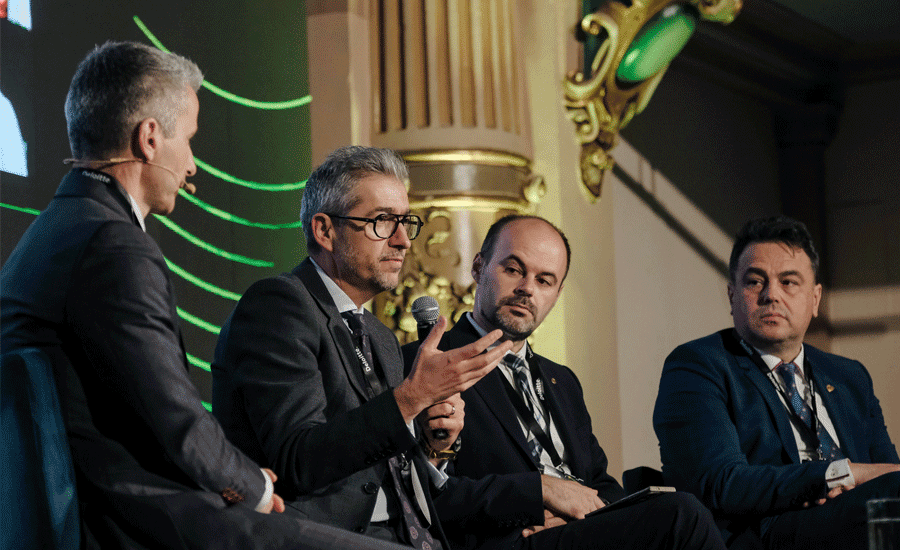
Aurel Bernat, CEO of BTAM: "To be an investor, you don't need a lot of money, you need discipline"

Aurel Bernat, CEO, BT Asset Management, gave an interview for HotNews.ro today, which we’re sharing here as well 😊. Today’s theme: debunking the myths around saving and investing.
Is saving only for people with high incomes?
Everyone has expenses relative to their income. How we manage those expenses is up to each of us. So I don’t believe you need what are considered large sums to start investing or saving. We can start with small amounts; we should all save, generally through easy-to-access, low-risk products. My answer is: whether we save or not doesn’t depend on our income.
If my salary isn’t 5,000 lei, but only 3,000 lei, can I think about smart saving? If so, how should I go about it?
Anyone can think about saving, and more importantly, we should start when we’re young. Looking around, we see lots of discussions about pensions, retirement and so on. The key is to realize that the earlier we save, the easier and better life will be towards the end of our careers. That’s really the most important point. Start putting money aside from a young age; teach our children, our families and those around us to save as well. Once you take this first step, the rest follows.
First and foremost, saving means putting money aside regularly, month after month, not necessarily large amounts — and making it a habit.
If we look at official data, 3,000 lei is close to the average salary in Romania right now. At this income level, I’d expect a substantial savings rate — not necessarily large sums in absolute terms. At this level of income we should, as a matter of course, have a savings component, with each of us setting our own level. We definitely need that safety net because, if we look around, in recent months reality has been a bit different from what we were used to, which is why each of us needs that security.
We used a football analogy in the previous interview. Let’s stay with sport, where discipline is crucial. What does discipline mean when we talk about investing?
Sticking with sport — and I see it with my own children as they start performance sport — you need determination at the outset. We need to decide and be determined to save. The stronger the determination, the more it becomes a habit. Once we’re truly “athletes,” the habit helps. Any one of us can decide to save; what matters is sustaining it over the long term.
Let’s not save more than we can afford, piling up a lot in the first months and then burning out as “saving athletes.” That’s not the point.
The point is endurance. I, for one, run. Running, especially long-distance, means starting at a pace that doesn’t tire you and keeps you happy over the long run. That’s exactly what we should do: begin with modest amounts and enjoy saving and watching it add up.
It’s very important to watch your balance. Over time, interest and gains accumulate, depending on how you save, and eventually you feel the satisfaction of having achieved it.
It’s the same in sport as it is with saving.
If we split the two components you mention — resources and discipline — what would be the share of each in successful saving?
Discipline matters far more than resources. Many of us, if we look at reality and at ourselves, can smile at this answer because it holds true for a lot of people. It’s not necessarily lower incomes that stop us from saving, but the habit of spending more when our incomes rise. We first need the habit of saving — I’d say roughly 80% — and the remaining 20% is the money component and the volume of inflows.
How long does it take to build an investment? After how long should we look at its performance?
Let’s define the long term in saving. Six months isn’t long term. One to two years isn’t long term. For saving, long term clearly extends beyond five years, and if we’re doing it for future wellbeing, we should probably look five to ten years ahead. In that five-to-ten-year frame, compound interest really matters. Saving today at a rate of 3–4–5%, compounding over time delivers generous returns from the accumulated interest, not necessarily from your financial effort.
Long term isn’t about your current situation and the next few years; it means five to ten years. For saving, that’s the horizon.
If we look at investment funds, there are various categories. Fixed income funds (bonds, government securities, bank deposits) follow the same reasoning as saving.
Another type is equity funds, where, depending on our involvement or how we read the market, we can benefit over shorter periods from its fluctuations.
I’d urge people — friends — to think long term; it’s healthier. Short-term swings happen, but the long-term goals are what matter.
What do we do if performance is weak — wait, exit, diversify, increase contributions?
There’s that saying: buy low, sell high. Generally we don’t stick to it. When there’s a correction or a crisis in the market, we feel it will affect us directly and we get scared. Understandably.
There are only two options:
- Keep my holdings as they are.
- Keep my holdings and stick to my habit.
In my view, option two wins. I keep my holdings and stick to my routine for as long as I can afford it. Crisis periods — I’m referring here to equities — bring attractive prices. Being able to buy assets at lower prices during certain periods greatly improves future returns.
I’d opt to hold. If you’re not forced to sell, don’t sell, and keep up the saving habit.
You can watch the full video interview here: