BT Analysis: Romania — From Local Market to a European Investment Platform

Romania’s membership of the European Union has reshaped the economy and the way the country is viewed on the investment map. Access to the single market, the free movement of capital and common rules have made it possible to think about investing in Romania beyond the country’s borders, as part of a strategy for the European market as a whole.
This is relevant both for European companies and for investors from outside the European Union. For an American or Asian company, for example, Romania can be a market with potential and, at the same time, a gateway to the European economy. The country’s location, people’s skills and development opportunities have all gained even greater relevance through Romania’s EU membership.
Nearly 135 billion euros in foreign investment in Romania
The scale of Romania’s transformation shows most clearly in foreign direct investment (FDI). According to National Bank of Romania data, the stock rose from 42.77 billion euros at the end of 2007 to 134.82 billion at the end of 2025.
EU accession is not the sole explanation for this trend, as foreign capital was present in Romania before 2007. But the figures do show a step change: in less than two decades, the stock of foreign direct investment has almost tripled as Romania’s economy has become increasingly connected to European and global capital flows.
Investment doesn’t grow in a straight line
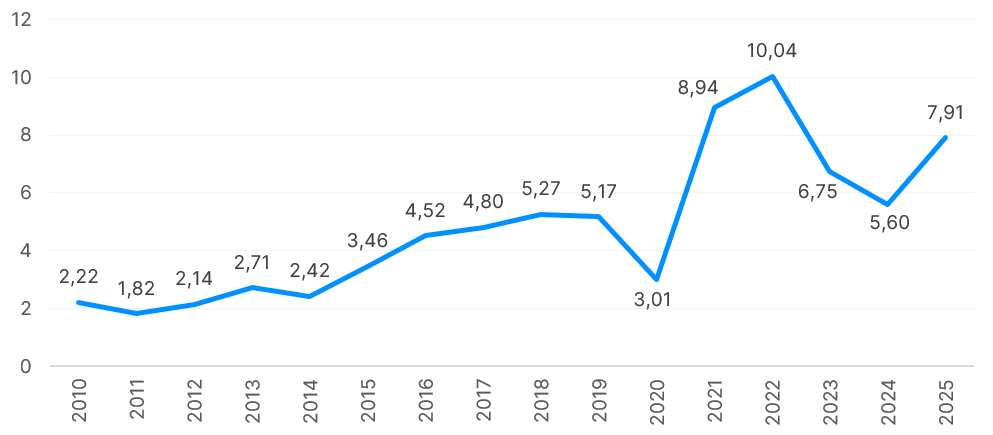
If the FDI stock shows the accumulated foreign capital in the economy, net flows capture the investment attracted in a given year, both through new projects and through funding for companies already operating in Romania. The last 20 years show that EU membership has increased Romania’s appeal to capital without insulating it from global cycles and crises:
- The first years after EU accession brought substantial capital inflows: 7.25 billion euros in 2007 and 9.5 billion euros in 2008.
- The global financial crisis changed the dynamics, and investment fell step by step to 1.82 billion euros.
- The recovery from the crisis was gradual. From 3.46 billion euros in 2015, net FDI flows reached 5.27 billion in 2018 and 5.17 billion in 2019.
- The pandemic triggered another setback, to 3.01 billion euros in 2020, followed by a strong rebound: 8.97 billion in 2021 and 10.59 billion in 2022.
- After cooling in 2023–2024, investment accelerated again in 2025, when net flows reached 7.91 billion euros, up 41.1% on the previous year.
Net foreign direct investment flows into Romania
2010–2025 | EUR bn
Trade connects markets, and investment connects economies. The big picture is what matters: between 2015–2025, Romania attracted net foreign direct investment flows of roughly 66 billion euros. Capital goes where it finds opportunities, confidence and prospects for growth. EU membership has made Romania more attractive to investment and much more connected to the European and global economy. The next step is for this connectivity to bring more technology, skills and impact.
Ioan Nistor, Chief Economist, Banca Transilvania, and author of the analysis Foreign direct investment in the context of Romania’s EU accession.

Where foreign capital has accumulated
Foreign investment is present across almost all major sectors of the economy, including: manufacturing (over 26%), construction and real estate transactions (18%), wholesale and retail trade (16%), financial services and insurance (15%) and extractive industries (6%).
Nearly 9 out of 10 euros of Romania’s FDI stock come from EU member states
The origin of capital shows how strongly Romania’s economy has plugged into Europe. In 2007, the main investors were Austria (21% of the FDI stock), the Netherlands (16%), Germany (12%) and France (9%). Twenty years later, the geography of investment has shifted, but the link with Europe remains dominant: the Netherlands (about 20%), Austria (around 15%) and Germany (12%). The most telling is the overall picture: EU member states together accounted for almost 87% of Romania’s foreign direct investment stock. For Romania, European integration is institutional and commercial — and visible in the structure of capital in the economy.
The next step: from Made in Romania to Created in Romania
Almost 20 years on from Romania’s EU accession, the question is what kind of investment the country can attract now. Infrastructure, education, skills and predictability can shift Romania toward more complex projects that bring more technology and greater impact. At the same time, Romanian companies can make more of the opportunities created by EU membership and connect in their turn to global value chains.
If the first two decades were about integrating Romania into Europe’s capital flows, the next stage can be about turning that integration into more value retained in Romania. At the same time, Romania can become an exporter of capital: there are Romanian companies strong enough to invest in other markets, internationally. A company’s maturity shows both in the capital it attracts and in the capital it starts to export.