BT CEO Ömer Tetik: "Performance demands pragmatism, but you can't do it without heart"
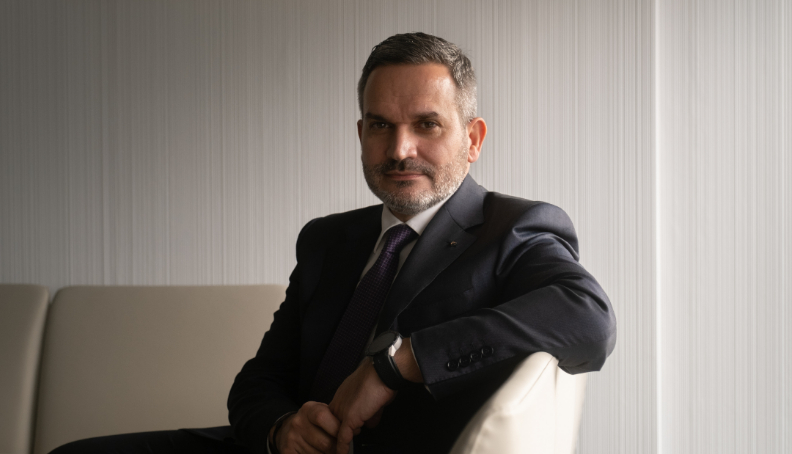
In September, Ömer Tetik, CEO of Banca Transilvania, gave an exclusive interview to Magazin Olimpic, the official magazine of the Romanian Olympic and Sports Committee. What performance looks like through the eyes of Banca Transilvania’s Chief Executive Officer, and where banking and sport intersect, comes through in the interview below.
You run a bank. You work with money, yet you once said a line you read in a specialist magazine really struck a chord: money should be in your head, not in your heart. Can we take the partnership with COSR as the part that speaks to the heart?
Banking is first and foremost about people, trust and performance. As for money, I believe we need to learn to use it as well as possible, to save, to make sure we always have reserves. In other words, not to spend money before we have it. You have to be pragmatic to achieve performance, but to grow you also need heart. The partnership with COSR, launched in January, is about both. We’re glad to support, over the next three years, the performance of Romanian athletes at the Olympic Games and at other competitions under the Olympic rings. Above all, it is a Banca Transilvania partnership for Romania, because athletes are role models for all of us and ambassadors of our country around the world.
One of the values COSR builds its mission on is National Pride. We can see that thread in Banca Transilvania’s philosophy too — not only in how the bank came to be, but also in the services you offer local entrepreneurs and the support for the small, local economy, as reflected in your “Cumpără de lângă tine” campaign. In a globalized world, does it still matter to turn back to tradition and national spirit?
Globalization has its advantages, and sport and we, the fans are among the main beneficiaries. It has transformed the world, with an impact on national economies, and thanks to it goods, money and information can travel faster and much farther. Sport itself has become a global industry thanks to its international and commercial dimension.
In all this, I believe national spirit should always be nurtured. So should the Olympic spirit. Every nation brings something unique to the world, and Romanians have plenty to be proud of. The first examples that come to mind are the athletes Romania has given the world. When people abroad are asked about Romania, the first words are often athletes’ names — Nadia Comăneci, Ilie Năstase, Gheorghe Hagi or Simona Halep, and David Popovici as well. Sport brings people together. The stands have a special vibe. They’re the place — perhaps the only one — where we see people sing the national anthem with their hand on their heart, with their mind on victory. That’s national pride, and we should pass it on every time we talk about Romania.
At BT we believe in the power of community, and sport brings people together. Banca Transilvania started 28 years ago with a team of 13 people, and today it ranks first and is the largest financier of the economy. The road to the podium, to a medal, owed a lot to the fact that we know Romania better than any other bank, that we are the bank on the way home. That we play at home, on our own turf. “Cumpără de lângă tine” and “Cumpără de la o afacere mică” are two of our initiatives for entrepreneurs. At BT, we’re the biggest supporters of entrepreneurs. The pandemic was a special way to say Hai, România! and to rally people so that we’re all on the same team.
Over time, COSR has brought on partners who gained an association with performance and the renown of sporting legends, and the benefit wasn’t just financial support; it also meant know-how, values, concepts and even management tools borrowed from business and used in sport. In that sense, what successful experiences at Banca Transilvania do you think COSR could benefit from?
It was hard to get to number one in banking, but it’s even harder to stay there. It’s exactly like an athlete’s life. I think there can be an interesting exchange of experience between BT and COSR. We have Romanian DNA, we back ideas, entrepreneurs, champions, performance. Faced with the question to us and to Romanian athletes alike, What have you done for Romania? we’d have an answer. In the end, we are what we do.
After the Tokyo Olympics, COSR’s leadership shaped a new strategy for the support it should provide to sustain performance. A number of transitions will follow, but the one I’d like to focus on is the shift from focusing exclusively on the athlete to multidirectional support that includes, of course, the athlete, but equally the coach, the medical team — from nutritionist to psychologist — and all the other specialists without whom the athlete, on their own, could not reach the highest performance. Science, technology and digitalization have, I believe, driven this transition. How do you view this approach? How is interdisciplinarity at BT?
Any athlete has a team behind them, and when they win, the team wins with them — and vice versa — so the initiative is welcome. In banking, as in any other field, interdisciplinarity means interdependence and complementarity. On top of that, the industry has become ever more complex — a combination of fintech and banking services. BT has hundreds of different roles, and success depends on everyone in the team contributing, each with their experience, specialization, energy and training. Individually, perhaps none of us are the very best bankers, but together we are the best bank. We perform if we collaborate and lift the bank — and performance — together. It’s like a football match, for example. Could one person cover the whole pitch? They couldn’t.
We live in a stressful world. Can setting performance targets motivate an athlete, or does it, on the contrary, agitate them and push them away from good results?
It depends on the person and what motivates them, but goals are more than necessary in any field, even more so in sport. They are milestones on the journey to success or to a better version of yourself as an athlete. It’s about perseverance, endurance and physical and emotional resilience.
The pandemic showed us that a long-term strategy isn’t the only tool we can use to develop an organization. Those who froze in place with plans that no longer fit the unexpected context suffered. Those who quickly understood what resilience involves and adapted to the new conditions not only survived — they grew and reinvented themselves. How did BT navigate the pandemic? Is there anything the world of sport could learn from this?
The pandemic was a match with lots of extra time for BT too, with the rules changing mid-game. But we adapted. From the way we worked as a team or with clients, to the projects we prioritized. On the positive side, the pandemic accelerated BT’s remote banking solutions, generated or reinforced certain trends, and contributed everywhere to the wider adoption of digitalization. I think the lesson for everyone was adaptation and patience — and that social distancing can bring us closer.
It’s no secret that Romanian sport is going through a difficult patch, driven first and foremost by the country’s economic and social situation, which has led to chronic underfunding. Of course, that’s not the only reason Romania no longer gets the results it used to; there are a number of interwoven factors, not just about us but also about what’s happening in sport globally. Even so, what we see happening in Romanian artistic gymnastics seems almost inconceivable. With a successful manager’s eye, where do you think the break occurred, and what should the recovery process start with in this discipline where the “perfect 10” was invented by a Romanian? And it wasn’t a one-off — we proved that later.
I believe the recovery of gymnastics depends on investment at every level and on shaping a winner’s mentality from a young age. Regardless of generation, we can have representation in the elite of world gymnastics. I hope we’ll be what we were again, because not every sport has “a Nadia Comăneci”.
You’re the number 1 bank in Romania. What is the road to being “the best”? That’s what all athletes dream of too — to be “the best”. How do you reach the top? And how do you stay there, with so many others almost as good as you aiming for that position? Does the recipe hold true for the world of sport, whether we’re talking about a nation, a club or simply an athlete?
As in sport, team spirit and a champion’s mindset are built and trained, and if you want to get to the top and stay there you have to do something extra. You reach the summit by conquering other, smaller peaks first. And once you’re up there, another challenge arises, perhaps a bigger one: how to stay there.
Just as important is respecting your teammates, your opponents and the crowd. I think it’s the same recipe for everyone; what matters is to value the journey, not just the destination — even if performance aims for the podium. Our goal is to be the bank that is closest to clients, to set an example for other Romanian businesses. It hasn’t been a priority to be the biggest in the industry. It’s the same for athletes: the most loved aren’t necessarily number one.
How is sport in your family? And I wouldn’t want you to talk only about engines, as we know you’re passionate about them, even if motorcycling is a beloved sport in our country but, unfortunately, practised less and less at performance level. I’d be interested in your thoughts on the link between sport and health, on what Americans have established through a study — that one leu invested in sport means 3 lei saved in the public health system — and perhaps on the transition from sport for health to performance sport, which at some point involves sacrifice and giving things up. Would you encourage your children to set out on such a path? Under what conditions?
Sport definitely contributes to a healthy lifestyle. I’m passionate about motorcycling, but it’s a hobby for me — more about relaxing. We’re all big basketball fans in the family — whether it’s the National Team or U-Banca Transilvania. Sport is part of my children’s education, and I owe that especially to my wife. I would certainly steer my children toward performance sport if I saw they had an inclination. Most importantly, through sport — even recreational sport — children learn to be good teammates, to persevere, to want to be superlative, and to know how to slalom through challenges, whatever they may be.
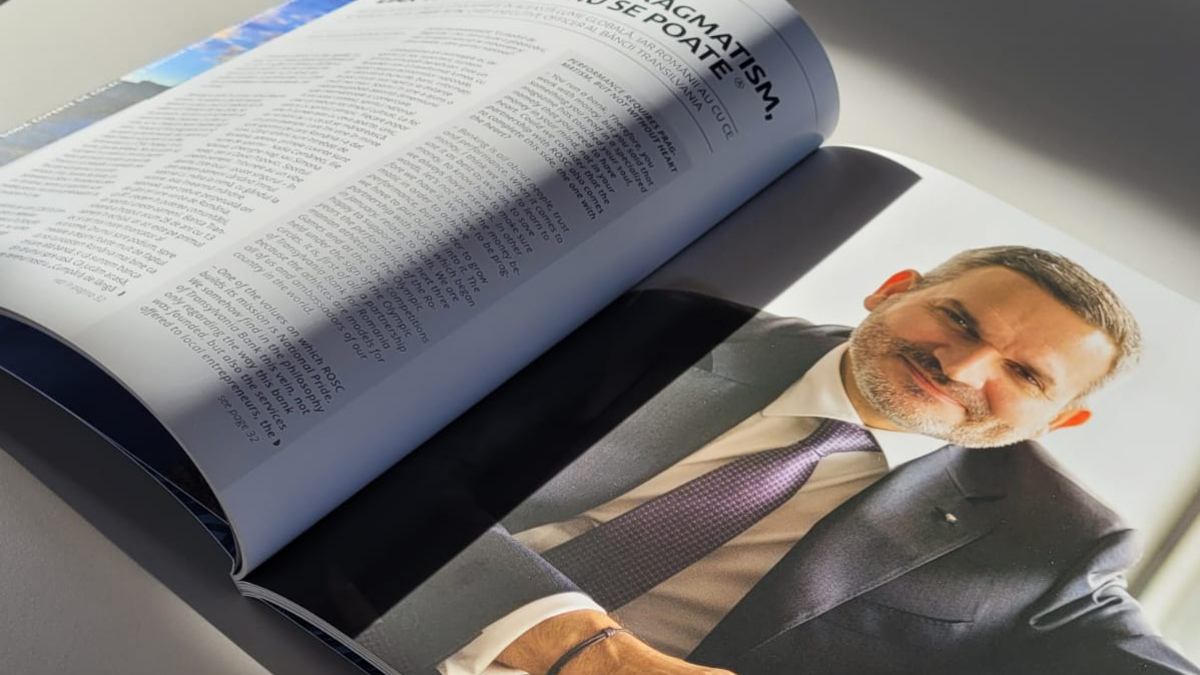
You can browse the interview here in Romanian and English.
Context
BT became the Official Bank of the Olympic Team Team Romania, thanks to the partnership with the Romanian Olympic and Sports Committee that began in January this year, supporting performance and Romanian athletes preparing to represent our country at the Olympic Games.
Through this partnership, some of Romania’s European champions are in the spotlight and we can get to know them better through the Between Medals campaign: Simona Radiș, Iulian Teodosiu, Robert Glință, Alexandru Novac, Adrian Șulcă, Laura Ilie, Bianca Ghelber, Andreea Ana.